
How Many Smoke Detectors Do I Need? A Comprehensive Guide for Every Home
- March 30, 2026
- 9 Min Read

- Working smoke alarms cut fire death risk by 60%.
- 7 smoke detectors minimum for a 3-bed, 2-story home.
- NFPA recommends one alarm per 900–1,200 sq ft.
- Dual sensor alarms cover both fire types.
- Test monthly, replace batteries every 6 months.
According to the latest NFPA research, when working smoke alarms are present in your home, the risk of dying in a home fire is cut by 60 percent. Imagine waking up at 2 a.m. to the sound of a smoke alarm. You have less than three minutes to get your entire family outside and safe. It is not a long time, and it’s exactly why having the right number of smoke detectors in your home isn’t just a recommendation, it’s a necessity. Yet many homeowners still ask: ” How many smoke detectors do I need?”
This comprehensive guide walks you through everything from how many smoke alarms your home needs to where to place them, which type to choose, and how to keep them working properly.
Table of Contents
Why the Number of Smoke Alarms in Your Home Matters?
Smoke alarms are your first line of defense against a house fire. They give your family an early alert, buying precious time to escape before fire and smoke spread through the house.
On average, families have less than three minutes from the moment the first smoke alarm sounds to safely escape. That’s an incredibly small window, and it shrinks even further if your alarms aren’t placed correctly or aren’t working at all.
Having a sufficient number of properly installed smoke alarms, placed in the right locations, is what maximizes your family’s escape time and keeps everyone safe. Having a sufficient number of properly installed smoke alarms, placed in the right locations, is what maximizes your family’s escape time and keeps everyone safe.
No amount of money can replace a life. Smoke alarms are not expensive, but the protection they offer is priceless.
How Many Smoke Alarms Do You Actually Need?
The answer depends on the size and layout of your house, but there are clear minimum standards set by the National Fire Protection Association (NFPA) that every homeowner should follow.
Here’s what the NFPA recommends as a baseline:
At least one smoke alarm on every level of the home, including the basement.
One smoke alarm inside every bedroom.
One smoke alarm outside each separate sleeping area.
One detector is near the base of the stairway leading to the upper floors.
For example, a 3-bedroom, 2-story house with a finished basement typically requires a minimum of 7 smoke detectors. That includes one in each bedroom, one on the main floor, one in the basement, and one on each level near the stairs leading between floors.
For very large homes, experts recommend at least one detector for every 900–1,200 square feet on each floor. Larger homes or those with complex, multi-story layouts may need additional strategically placed detectors to ensure every corner of the home, including the basement, is covered.
It’s also worth noting that homes built to earlier standards often don’t meet today’s minimum requirements for smoke alarms. If your home is older, verify current requirements with your local fire department or building authority, as local building codes can vary significantly by state and year of construction.

Where Exactly Do You Need Smoke Alarms Installed?
The answer to how many smoke alarms you need is not enough. Where you install smoke alarms matters just as much as how many you have. Here’s a room-by-room guide to proper smoke detector placement:
Bedrooms & Sleeping Areas
Smoke alarms should be installed inside every bedroom and outside each sleeping area. This ensures that if a fire starts while your family is asleep, the alarm sounds directly where people need to hear it most. Don’t assume one alarm in the hallway is enough; always place one inside each bedroom door area for maximum protection.
Hallways
Hallways are critical zones for alarm coverage. If a hallway is longer than 30–40 feet, install a detector at each end. The maximum distance between two smoke alarms should never exceed 30 feet to ensure full coverage.
Basement
One detector should always be installed in the basement. Fires can start in basements due to electrical issues, furnaces, or stored materials, and since smoke rises, a basement fire can quickly cut off escape routes if there’s no alarm to alert you in time.
Kitchen & Bathroom
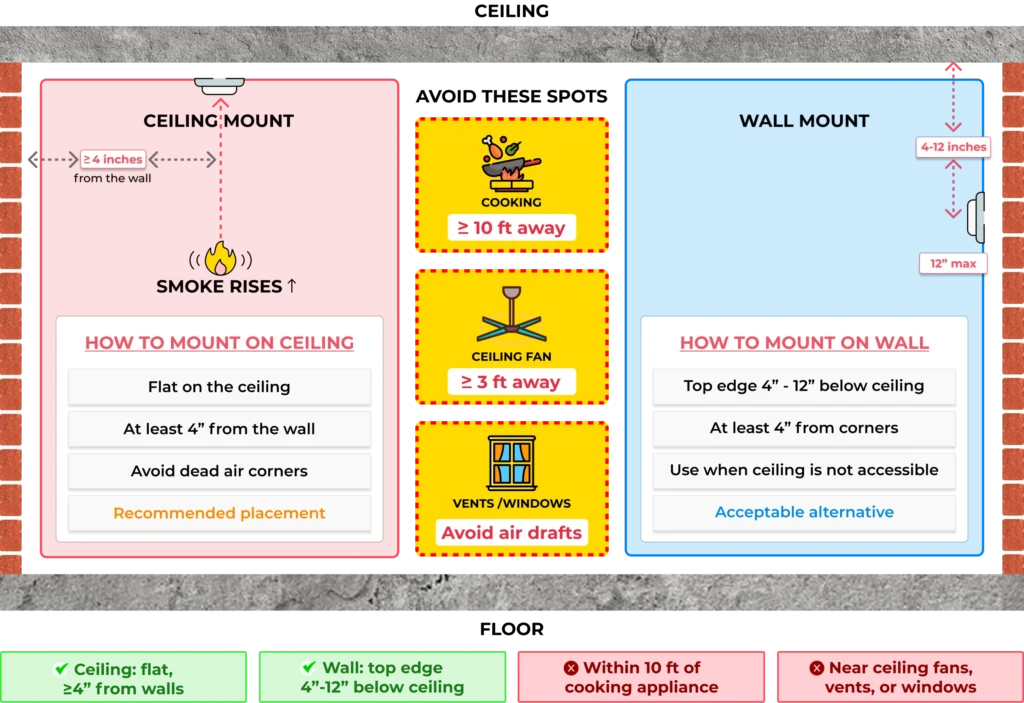
Smoke alarms can be sensitive to cooking smoke from the kitchen and steam from the bathroom, leading to false alarms. To minimize this, place smoke alarms at least 10 feet away from cooking appliances and away from bathroom steam if possible.
Stairs & Common Areas
There should be at least one smoke alarm placed on each level of the home in a common area, and one near the stairs leading between floors. This ensures the alarm sounds throughout the entire home when needed.
General Placement Tips
Always mount smoke alarms high on walls or on the ceiling, because smoke rises.
Keep the fire alarms away from vents, ceiling fans, and windows where airflow can interfere with detection.
Avoid dead air spaces like corners, where smoke might not circulate properly.
Types of Smoke Detectors: Which One Is Right for You?
Not all smoke detectors are the same. Understanding the different types helps you make the best choice for your home and family.
Ionization Smoke Alarms
Ionization smoke alarms work by ionizing the air between two charged plates using a tiny radioactive source. Smoke disrupts the current between the plates and triggers the alarm.
Photoelectric Smoke Alarms
These are more effective at detecting slow, smoldering fires, the kind that often start at night from furniture or electrical wiring.
The National Fire Protection Association (NFPA) recommends using both types either by installing separate ionization and photoelectric alarms, or by choosing dual sensor smoke alarms that combine both technologies in a single unit. This gives your home the broadest possible protection against all types of fires.
Hardwired Smoke Alarms
These are connected directly to your home’s electrical system. Many hardwired models also include a battery backup, so they continue to function even during a power outage.
Interconnected Smoke Alarms
Interconnected smoke alarms are one of the best safety upgrades you can make. When one alarm sounds, they all sound, ensuring every member of your family is alerted, no matter where they are in the house. In newer homes, interconnected smoke alarms are often required by building codes.
Combination Smoke & Carbon Monoxide Detectors
Carbon monoxide alarms are closely related to smoke detector requirements but serve a distinct purpose. Carbon monoxide is an odorless, colorless gas produced by any fuel-burning appliance, such as furnaces, gas ranges, fireplaces, and vehicles in attached garages.
Why Smoke Alarm Maintenance is Needed?
Maintenance of the smoke alarm is necessary; even the best smoke detectors are useless if they aren’t properly maintained.
Test Monthly
One should test smoke alarms every month using the test button to confirm they are working correctly. This simple habit ensures your alarms are always ready when you need them.
Replace Batteries Every 6 Months
You should test smoke alarms at least once a month by pressing the test button on every unit. If the alarm does not sound, replace the battery first. If it still fails after a fresh battery, replace the entire smoke alarm.
Follow Manufacturer’s Instructions
Always refer to the manufacturer’s instructions for model-specific guidance on installation, testing, and replacement.
Conclusion
Protecting your home and family from fire starts with having the right number of smoke alarms installed in the right places and kept in good working order. Whether you’re a first‑time homeowner or you’re revisiting your current fire‑safety setup, the message is clear: cutting corners on smoke detectors is not an option.
For professional fire‑safety teams, property managers, and inspection companies, managing this coverage at a scale can quickly become complex. That’s where ZenFire comes in, with ZenFire you can track, schedule, and verify every smoke alarm, fire extinguisher, and detector in your portfolio from a single dashboard.
Fire protection pros verify NFPA 72 smoke detector compliance using digital tools like ZenFire. With built-in NFPA checklists and AI-powered deficiency detection, ZenFire ensures every bedroom alarm, mounting height, and interconnection meets code during residential inspections.
If you are a fire protection company, book a free demo today and see how ZenFire can transform the way your fire protection business operates.

Get Insights Delivered Straight
To Your Inbox!
Related Reading

Why Your Field Software Management Software Needs QuickBooks Integration
ZenTrades Why Your Field Service Management Software Needs QuickBooks Integration Read More Request Demo...
Read More
ZenTrades How To Manage Electrical Service Agreements Like...
Read More
ZenTrades The Best 5 Jobber Alternatives In 2023...
Read More